|
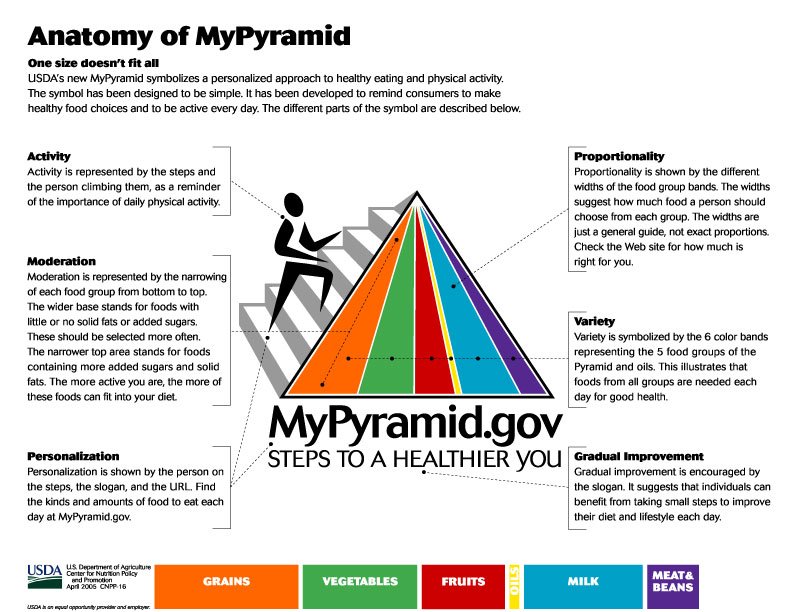
Spring into a Healthy Lifestylewith the New FoodGuidePyramid—or How to Put Spring into Your Step!
The new Food Guide Pyramid, pictured above, isthe tool to use to step into a healthy lifestyle by learning to balance the energy (calories) you obtain from foods that you eat and drink with the energy you expend via physical activity. This is the “low-fad” diet approach to a healthier you!
If you haven’t visited www.MyPyramid.gov , schedule a date with your computer to take a tour of the site. It will be one of the best investments in your health that you will make this year! The new Food Guide Pyramid, released in March 2005, was developed to guide the individual consumer in making appropriate food and activity choices that are compatible with attaining good health, as determined from reliable scientific evidence. The 2005 Dietary Guidelines is the document which describes in detail the scientific studies that have formed the basis for the dietary and activity recommendations outlined in MyPyramid.gov and may be accessed at: www.health.gov/dietaryguidelines.
The MyPyramid.gov website allows you to enter information about yourself (age, gender, activity level) to learn how many servings from each of the five major food groups (grains, vegetables, fruit, milk, and meat and beans) are recommended for you to maintain your current weight. It also allows you to determine the number of “extra” calories (called discretionary calories) you can fit into your food “budget” to maintain your current weight. Discretionary calories are calories that are contributed by foods that donot contain many essential nutrients (vitamins, minerals), such as candy, sodas, alcoholic beverages, and solid fats. The wisest way to reduce your current weight (if you are overweight), without sacrificing your long-term health, is to consume the number of servings of food you need every day from each of the five major food groups, according to the MyPyramid.gov plan, and to reduce the number of discretionary calories you consume. Detailed information regarding weight control may be found in the MyPyamid.gov website. Sample menus are provided on the website, and you can even analyze your own diet and activity patterns and receive feedback as to how your habits compare with the recommended food intake and activity goals for good health.
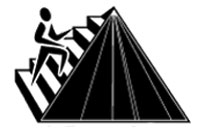 The new Food Guide Pyramid depicts a person climbing stairs up one side of the pyramid. This is to emphasize the inclusion of daily purposeful activity (undertaken at a moderate pace) to balance the energy you obtain from the foods you eat and drink to achieve good health. In the past, Dietary Guidelines made recommendations regarding the importance of daily exercise, but this is the first time exercise has been symbolized within the Food Guide Pyramid. On MyPyramid.gov, you can enter the type, duration, and frequency of daily activities you undertake, to determine how your activity patterns measure up to recommended levels. Generally, children and adolescents need to accumulate 60 or more minutes of moderate physical activity/day (equivalent to walking at 3-4 m.p.h.), as do adults trying to lose weight or maintain weight loss. Others need to accumulate at least 30 minutes of moderate physical activity/day. The good news--the daily activity goal can be met in increments---such as 10 minutes at a time, rather than trying to exercise for 30 or 60 minutes all at once. The new Food Guide Pyramid depicts a person climbing stairs up one side of the pyramid. This is to emphasize the inclusion of daily purposeful activity (undertaken at a moderate pace) to balance the energy you obtain from the foods you eat and drink to achieve good health. In the past, Dietary Guidelines made recommendations regarding the importance of daily exercise, but this is the first time exercise has been symbolized within the Food Guide Pyramid. On MyPyramid.gov, you can enter the type, duration, and frequency of daily activities you undertake, to determine how your activity patterns measure up to recommended levels. Generally, children and adolescents need to accumulate 60 or more minutes of moderate physical activity/day (equivalent to walking at 3-4 m.p.h.), as do adults trying to lose weight or maintain weight loss. Others need to accumulate at least 30 minutes of moderate physical activity/day. The good news--the daily activity goal can be met in increments---such as 10 minutes at a time, rather than trying to exercise for 30 or 60 minutes all at once.
GRAIN GROUP Make half your grains whole
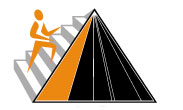 As in the former Food Guide Pyramid, the color bands of varying widths in MyPyramid.gov correlate with the number of servings that are required from each of the major food groups to maintain good health. Orange represents the grain group. The orange band width is the widest of all the color bands in MyPyramid.gov, indicating that grains should make up the greatest part of our diet. This guideline does not differ from past recommendations. However, the emphasis in MyPyramid.gov is placed upon the need to consume whole grains. In fact, at least half of the recommended number of servings from the grain group should be whole grains (whole wheat, whole oats, barley, quinoa, brown rice, etc.). As in the former Food Guide Pyramid, the color bands of varying widths in MyPyramid.gov correlate with the number of servings that are required from each of the major food groups to maintain good health. Orange represents the grain group. The orange band width is the widest of all the color bands in MyPyramid.gov, indicating that grains should make up the greatest part of our diet. This guideline does not differ from past recommendations. However, the emphasis in MyPyramid.gov is placed upon the need to consume whole grains. In fact, at least half of the recommended number of servings from the grain group should be whole grains (whole wheat, whole oats, barley, quinoa, brown rice, etc.).
VEGETABLE GROUP Vary your veggies
FRUIT GROUP Get your fruits
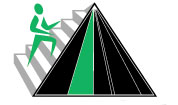 |
The green color band represents vegetables, and the red band represents fruits; you need to strive to choose a variety of fruits and colorful vegetables each day for good health. French fries as your main vegetable and apple juice as your main source of fruit are not what MyPyramid.gov had in mind! What’s new in MyPyramid.gov is that guidelines are given for the number of cups of various types (and colors) of vegetables that are required weekly for good health. This has been done to guide the consumer in making choices that will maximize their nutrient intake, as various fruits and vegetables differ significantly in their nutrient content
|
 |
MILK GROUP Get your calcium-rich foods
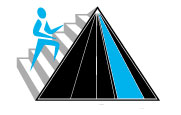 The blue color band represents milk and foods made from milk. The new pyramid calls for an increased intake of milk (3 cups per day) for ages 9 and above to ensure adequate calcium and vitamin D intake for bone health. It is important to note that milk is fortified with vitamin D, a nutrient required for your body to use calcium effectively. Most cheeses, ice cream, and yogurts, however, are not fortified with vitamin D, a nutrient that your skin can manufacture when exposed to sufficient sunlight. Older people, people with darker skin, people who do not venture outside during daylight hours, and people who live in northern climes from late fall to early spring cannot obtain enough vitamin D solely through sun exposure to meet their requirements. It is therefore important for them to consume milk or other foods fortified with vitamin D (some cheeses, yogurts, cereals, orange juice), according to MyPyamid.gov to ensure adequate intake of vitamin D and bone health. The blue color band represents milk and foods made from milk. The new pyramid calls for an increased intake of milk (3 cups per day) for ages 9 and above to ensure adequate calcium and vitamin D intake for bone health. It is important to note that milk is fortified with vitamin D, a nutrient required for your body to use calcium effectively. Most cheeses, ice cream, and yogurts, however, are not fortified with vitamin D, a nutrient that your skin can manufacture when exposed to sufficient sunlight. Older people, people with darker skin, people who do not venture outside during daylight hours, and people who live in northern climes from late fall to early spring cannot obtain enough vitamin D solely through sun exposure to meet their requirements. It is therefore important for them to consume milk or other foods fortified with vitamin D (some cheeses, yogurts, cereals, orange juice), according to MyPyamid.gov to ensure adequate intake of vitamin D and bone health.
MEAT & BEANS GROUP Go lean with protein
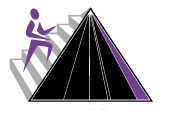 The purple colored band represents the meat and beans group, a good source of protein, zinc, iron and Vitamin B12 . You might notice that despite our love affair with protein in the U.S., the band width of this food group is relatively narrow. This is because the average person needs to consume the amount of food from this group equivalent in size to only two decks of cards per day; hence, the reason for the narrow band width of this group, indicating the need for a modest intake of meats and beans, compared with the intake of foods from other food groups. As the slogan indicates, choices from this group should be lean…skinless poultry; lean cuts of beef, pork, lamb, and veal preferably grilled or roasted, not fried; beans and peas cooked with a minimal amount of added fat. The purple colored band represents the meat and beans group, a good source of protein, zinc, iron and Vitamin B12 . You might notice that despite our love affair with protein in the U.S., the band width of this food group is relatively narrow. This is because the average person needs to consume the amount of food from this group equivalent in size to only two decks of cards per day; hence, the reason for the narrow band width of this group, indicating the need for a modest intake of meats and beans, compared with the intake of foods from other food groups. As the slogan indicates, choices from this group should be lean…skinless poultry; lean cuts of beef, pork, lamb, and veal preferably grilled or roasted, not fried; beans and peas cooked with a minimal amount of added fat.
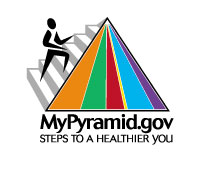 The narrow yellow color band represents oils, which should make up a very small part of our diet, as oils (and fats) contain a large number of calories in a small volume. Emphasis is placed on using the types of oils that are heart healthy (fish oils, olive oil, canola oil, and smaller amounts of other oils such as safflower, sunflower, corn, and soybean). Finally, the base of MyPyramid.gov promotes choosing foods that are low in fats and sugars, and the tip of the pyramid (just like in the older version) suggests choosing very few foods that contain a lot of fat and sugar and that contain hardly any essential nutrients. For example, whole wheat bread would belong at the base of MyPyramid.gov’s orange group, as it is made from grain and contains little added sugar and fat. Doughnuts, while still belonging in the orange group (because they’re made from flour—a grain), would belong at the tip of the Pyramid because they contain a lot of sugar and fat in comparison to the other essential nutrients they supply, and should be consumed infrequently. The narrow yellow color band represents oils, which should make up a very small part of our diet, as oils (and fats) contain a large number of calories in a small volume. Emphasis is placed on using the types of oils that are heart healthy (fish oils, olive oil, canola oil, and smaller amounts of other oils such as safflower, sunflower, corn, and soybean). Finally, the base of MyPyramid.gov promotes choosing foods that are low in fats and sugars, and the tip of the pyramid (just like in the older version) suggests choosing very few foods that contain a lot of fat and sugar and that contain hardly any essential nutrients. For example, whole wheat bread would belong at the base of MyPyramid.gov’s orange group, as it is made from grain and contains little added sugar and fat. Doughnuts, while still belonging in the orange group (because they’re made from flour—a grain), would belong at the tip of the Pyramid because they contain a lot of sugar and fat in comparison to the other essential nutrients they supply, and should be consumed infrequently.
MyPyramid.gov is an exciting tool that will allow you to plan a diet, tailored to your special needs and profile, and if followed closely, is bound to put some spring in your step! To help you start on the path to better health, try our spring recipe for Cindy's Healthier Lasagna with No-Cooked Noodles on the "What's Cooking" tab that can be made in a flash!
|